
If you're running a SaaS content team, you know the feeling: you publish a great article, it gets some traction, and then… you're back to square one. LinkedIn needs posts. Your email list hasn't heard from you in a week. Twitter is silent. The content treadmill never stops.
Here's the truth: you don't need to create more content. You need to make your existing content work harder.
Content repurposing is the practice of turning one text asset into many text assets, each tailored to different channels and contexts. It's not about copy-pasting the same thing everywhere - it's about adapting your message to meet your audience where they are, in the format they prefer.
This guide focuses exclusively on repurposing text content: blog posts, documentation, emails, social posts, and sales copy. No video or audio. Just words that convert.
Modern tools like RePurpose.ws can transform a single long-form article into platform-ready posts for X, LinkedIn, Reddit, and more in under a minute. But technology is only part of the equation. By the end of this guide, you'll know how to build a repeatable, text-only repurposing system that scales with your SaaS.
What Is Content Repurposing?
Core Definition

Let's clear up some confusion first. Content repurposing is not the same as reposting or refreshing.
Reposting means sharing the exact same content again, hoping new eyeballs will find it. Refreshing means updating an existing piece with new data or information.
Repurposing means adapting the format, angle, and depth of the same core idea for different channels and audiences.
When you repurpose a blog post into a LinkedIn carousel, you're not just shortening it - you're changing the structure, adjusting the tone, and highlighting the aspects that resonate on that platform. The underlying idea stays the same, but the execution is completely different.
In this guide, we're focused on text-based channels: blogs, documentation, newsletters, social posts, sales emails, community forums, and in-app copy. These are the channels where SaaS companies live and breathe.
Why SaaS and Content Teams Need It

SaaS companies face a unique content challenge. Your buying cycles are long. Your customers need multiple touchpoints before they convert. They interact with your brand across a dozen different channels: your blog, social media, email, product docs, community forums, and more.
Each of these touchpoints requires fresh content, but you don't have the resources to create something entirely new for every channel. This is where repurposing becomes essential. One well-crafted blog post can fuel your content engine for weeks, supporting every stage of the funnel from awareness to post-purchase engagement.
Budget and headcount constraints make repurposing even more critical. Instead of linear returns where each hour of work produces one piece of content, repurposing gives you compounding ROI. The same effort produces ten or twenty derivatives that work together to reinforce your message.
Beyond efficiency, repurposing ensures consistency. When your product team, marketing team, sales team, and customer success team all draw from the same core content assets, your messaging stays aligned. Your prospects hear the same value propositions whether they're reading your blog, talking to sales, or browsing your help center.
What Content Repurposing Is Not
Let's be clear about what we're not doing here.
Content repurposing is not copy-paste syndication. You can't take the same 2,000-word blog post and paste it into an email, a LinkedIn post, and a Reddit thread. Each channel has different norms, different audience expectations, and different levels of awareness. What works in long-form doesn't work in micro-content, and vice versa.
This also isn't "content spinning" for SEO purposes. We're not creating low-quality variations to game search engines. Every repurposed piece should add genuine value and serve a specific strategic purpose.
Good repurposing requires thoughtful adaptation based on:
- Audience awareness level: Does this audience already know your product, or are they encountering your ideas for the first time?
- Channel norms: What length, tone, and structure work best on this platform?
- Funnel stage: Is this content meant to attract attention, build consideration, or close deals?
Benefits of Text-Only Content Repurposing for SaaS

Make Each Article a Content "Asset", Not a One-Off
Most SaaS teams treat blog posts as disposable. You publish, promote for a day or two, and move on. The post sits on your blog, slowly accumulating some SEO traffic, but it's essentially done working for you.
This is a massive missed opportunity.
When you adopt a repurposing mindset, every article becomes a strategic asset that generates dozens of derivatives. One comprehensive guide becomes: three LinkedIn posts explaining different frameworks, a five-part email sequence for new subscribers, two Reddit threads addressing common pain points, a set of FAQ answers for your help center, and several X threads that position your founder as a thought leader.
Each derivative reaches a different audience segment, reinforces your core message from a new angle, and extends the lifespan of your original investment. That single article isn't just working on your blog anymore - it's working everywhere.
Support the Entire SaaS Funnel
Your content needs to serve prospects at every stage of their journey.
At the awareness stage, you need educational content that doesn't pitch your product directly. Repurpose your thought leadership articles into LinkedIn posts, X threads, and Reddit contributions that establish authority and attract cold traffic.
During consideration, prospects are comparing solutions and evaluating options. Turn your case studies into detailed comparison posts, your product guides into email sequences that address common objections, and your feature announcements into LinkedIn content that demonstrates your velocity.
At the decision stage, prospects need that final push to convert. Repurpose customer testimonials into social proof snippets, your documentation into "how we're different" landing page copy, and your support content into FAQ sections that remove last-minute friction.
Even post-purchase, repurposing supports your customer success efforts. Your changelog becomes onboarding emails. Your advanced guides become in-app tips. Your community answers become help center articles.
One piece of content can support all of these stages - if you're intentional about how you adapt it.
Save Time and Reduce Burnout
Let's talk about the math.
Creating a 2,000-word blog post from scratch might take you six to eight hours: research, outlining, drafting, editing, optimizing. That's one piece of content for one channel.
Now imagine taking that same blog post and spending two hours repurposing it into ten derivatives: three email segments, four social posts, two community contributions, and one landing page section. You've just created eleven pieces of content in ten hours total, versus what would have taken you sixty to eighty hours if you created each one individually.
That's not just an efficiency gain - it's the difference between keeping up with your content calendar and falling hopelessly behind.
For small teams especially, repurposing is the difference between burnout and sustainability. You maintain consistent visibility across channels without the constant pressure to produce entirely new ideas every single day.
Strengthen Brand Voice and Thought Leadership
When you repeat the same core ideas in different formats across different channels, something powerful happens: you become known for those ideas.
Your audience starts associating your brand with specific concepts, frameworks, and perspectives. This is how thought leadership actually works - not by saying something once and hoping it sticks, but by approaching the same territory from multiple angles until your point of view becomes unavoidable.
Repurposing helps you own a topic in your niche. If you've written the definitive guide on a subject, you should be talking about aspects of that guide for months, not days. Each repurposed piece reinforces the themes that matter most to your positioning, building a recognizable "content signature" that makes your brand memorable.
The Building Blocks: Source Text Content You Can Repurpose
Primary "Source" Assets

The best source material for repurposing is content that's substantial, strategic, and evergreen.
Long-form blog posts and guides are ideal. They contain multiple ideas, examples, and frameworks that can be extracted and reformatted. A 3,000-word guide might contain ten distinct concepts, each of which can become its own social post or email.
Whitepapers, reports, and ebooks are goldmines. These are your most researched, most authoritative content pieces. They're also usually gated or under-promoted, which means most of your audience has never seen them. Breaking them into smaller, accessible pieces gets that valuable research in front of more people.
Case studies and customer stories work beautifully for repurposing. The narrative structure adapts well to different formats: the full story becomes a blog post, the key results become a LinkedIn post, the challenges become a "here's what we learned" thread, and the testimonial becomes social proof across your site.
Product update posts and changelogs shouldn't just live in your product. Each significant feature can become an educational blog post, a series of tips on social media, and content for your email nurture sequences.
Internal Goldmines (Usually Ignored)
Most SaaS companies are sitting on a treasure trove of repurposable content that never sees the light of day.
Your help center articles and product documentation solve real problems for real users. These same problems are being discussed on Reddit, LinkedIn, and Twitter by people who've never heard of you. Turn your best help articles into educational content that reaches prospects before they become customers.
Support tickets reveal the questions your audience is actually asking. The "how do I…" questions that come up repeatedly should become blog posts, social content, and FAQ entries. Your support team is telling you exactly what content your market needs - listen to them.
Sales call notes and objection lists are pure gold. Every objection is a content opportunity. "We're not sure this will work for our industry" becomes a case study. "This seems expensive" becomes a cost-benefit blog post. "We need to compare you with X" becomes a comparison page.
Internal documentation - your strategy memos, Notion docs, and Slack threads - often contain the most honest, clear explanations of your thinking. Strip out the confidential bits and these become some of your most authentic content pieces.
Content to Avoid Repurposing (or Use Carefully)
Not all content ages well.
Outdated messaging and deprecated features should stay in the archives. If you've pivoted your positioning or discontinued a product line, don't confuse your audience by bringing that content back into circulation.
Highly time-bound announcements lose their value quickly. But here's the thing: you can often extract evergreen lessons from timely content. "We just raised a Series B" is time-bound. "What we learned while raising our Series B" is evergreen.
A Simple Framework: From One Text Asset to a Full Content System
Let's talk about process. How do you actually take one piece of content and turn it into a dozen?
Start with a "Hero" Text Asset
Not every piece of content deserves to be repurposed. Start with your strongest material.
Choose a high-performing, evergreen blog post or guide that meets these criteria:
- Strong historical performance (traffic, engagement, conversions)
- Strategic topic aligned with your product and positioning
- Clear point of view that differentiates your brand
- Substantial length with multiple distinct ideas
This becomes your "hero" asset - the anchor for your repurposing system.
Break It Down into "Idea Atoms"
Read through your hero asset and extract the individual building blocks:
- Key hypotheses and claims: What's the main argument? What controversial or counterintuitive points do you make?
- Data points and examples: What stats, case studies, or concrete examples support your points?
- Step-by-step processes: What tactical frameworks or methods do you explain?
- Quotes and strong one-liners: What phrases or sentences would work well as standalone content?
Each of these is an "idea atom" - a self-contained concept that can be reformatted for different channels.
Map Idea Atoms to Text-Based Formats
Once you have your atoms, you map them to appropriate formats:
- Short-form: X posts and threads, LinkedIn posts, Reddit comments, quick tips for newsletters
- Medium-form: Newsletter segments, nurture email sequences, FAQ entries, community posts
- Long-form: Spin-off blog posts, comparison articles, pillar pages, in-depth LinkedIn articles
The same idea atom might become all three. A framework explained in your blog post becomes: a detailed LinkedIn post (medium), a quick-tip X thread (short), and a dedicated how-to article (long).
Use a Consistent "Repurpose Grid"
Build a simple matrix to guide your decisions:
Rows represent your source content types:
- Blog posts
- Case studies
- Product updates
- Help documentation
- Reports and research
Columns represent your target formats:
- X threads
- LinkedIn posts
- Email sequences
- Landing page sections
- FAQ entries
- Community posts
- Newsletter content
For each source type, you define which target formats make sense and what the adaptation rules are. This grid becomes your repeatable system - no need to reinvent the process every time.
Channel-by-Channel: How to Repurpose Text Content for SaaS

Let's get specific about how to adapt your content for each major channel.
Website & Blog
Your blog shouldn't be a collection of isolated posts. It should be a content ecosystem where pieces connect and reinforce each other.
Turn one comprehensive guide into a cluster of spin-off posts. If you've written "The Complete Guide to SaaS Metrics," that can become separate posts on CAC payback, net revenue retention, and rule of 40 - each linking back to the main guide.
Extract common questions and answers to build robust FAQ and glossary pages. These serve both SEO and user experience, while requiring minimal additional writing.
Break down product-focused sections into feature-specific how-to articles. Your product update announcing a new integration can become a standalone tutorial, a troubleshooting guide, and a best practices post.
Email & Marketing Automation
Email is where repurposing really shines. Every blog post contains multiple email-worthy ideas.
Your comprehensive guide becomes a five-part welcome sequence for new subscribers. Each email focuses on one key concept, written in a more personal tone than your blog, with a clear call-to-action.
Feature announcements become onboarding emails that guide new users toward activation. Educational content becomes nurture sequences that move prospects through the funnel.
Even your best-performing social posts can be adapted into reactivation campaigns for dormant users.
The golden rule: one main idea per email, with a single clear CTA. Don't try to cram an entire blog post into one email - that's not repurposing, that's just bad email marketing.
LinkedIn (for Founders, PMMs, and Content Leads)
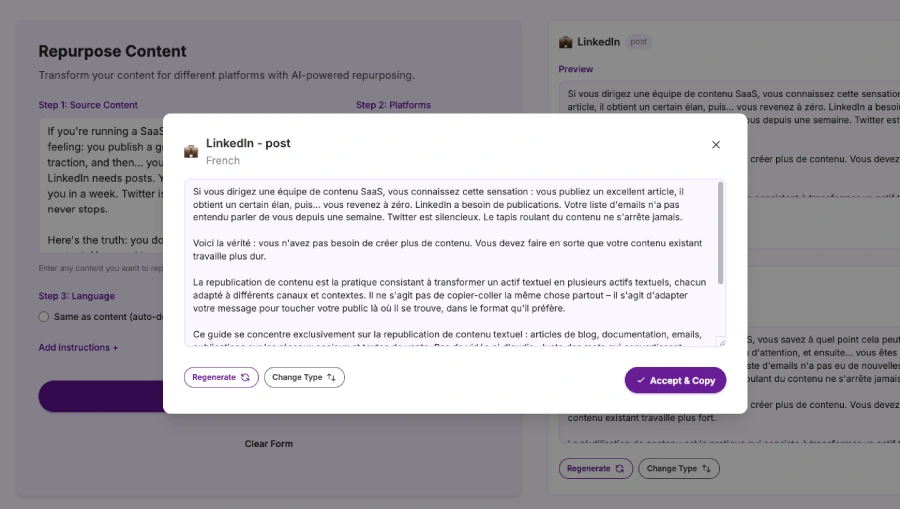
LinkedIn rewards well-structured, opinionated content from real people.
Turn key sections from your blog into opinion posts where you take a clear stance on an industry debate. The same argument you made in paragraph three of your blog post becomes a 300-word LinkedIn post from your founder or head of marketing.
Describe your frameworks as text-based carousels, where each "slide" is represented as a numbered section in your post. "Here are the 5 stages of SaaS content maturity: 1. Random acts of content… 2. Channel consistency…" and so on.
Extract your step-by-step processes into tactical checklists. "Here's how we reduced churn by 23%: ✓ First, we… ✓ Then we… ✓ Finally…" These perform exceptionally well because they're actionable and skimmable.
X/Twitter
X rewards brevity, clarity, and hooks that stop the scroll.
Turn your best articles into X threads that summarize the core argument in 5-10 tweets. Start with a hook pulled directly from your blog's introduction, then break down your main points with one idea per tweet.
Create single-tweet micro-lessons from your strongest one-liners. That sentence buried in paragraph seven? It might be your next viral tweet.
Use your blog's subheadings as thread hooks. "Most SaaS companies are wrong about content ROI. Here's why:" leads into a thread about measurement frameworks.
The key is writing for X norms: short sentences, active voice, conversational tone. You're not summarizing your blog - you're reimagining it for a different medium.
Communities (Reddit, Slack, Discord, Forums)
Community platforms punish self-promotion but reward genuine helpfulness.
Turn your advice sections into long-form comments that solve specific problems. When someone on Reddit asks "How do you measure content ROI?" and you've written a blog post about it, you don't link to your blog - you give them a condensed, practical answer in the comment, tailored to their specific situation.
Use your case studies as "here's what worked for us" posts in relevant communities. Share the story, the numbers, and the lessons without making it about your product.
Your best blog content becomes AMA answers when you participate in community discussions. You're not starting from scratch - you're pulling from your library of already-written ideas.
Sales and Customer Success
Your content team's work should directly support revenue teams.
Turn objection-handling sections from your blog into battlecards for sales reps. Each common objection gets a concise response, backed by data and examples from your content.
Create template email responses from your FAQ content. When a prospect asks "How does your pricing work?" your sales team shouldn't write that from scratch - they should have a polished, brand-consistent template adapted from your pricing guide.
Develop "how to pitch this feature" guides from your product content. When you launch something new, your customer success team needs simple, clear language to explain it. Your announcement blog post contains that language - extract it, simplify it, and format it for internal use.
Using AI to Scale Text Repurposing (Featuring RePurpose.ws)

When Manual Repurposing Stops Scaling
There comes a point where doing everything manually becomes a bottleneck.
The warning signs are obvious: you have a backlog of great content that never gets repurposed, your posting frequency is inconsistent across channels, and your team spends more time adapting content than creating it.
Meanwhile, your competitors are flooding LinkedIn, X, and Reddit with consistent messaging. You know you should be doing the same, but you don't have the bandwidth.
This is when AI tools stop being a nice-to-have and become essential infrastructure.
How RePurpose.ws Fits Into Your Workflow
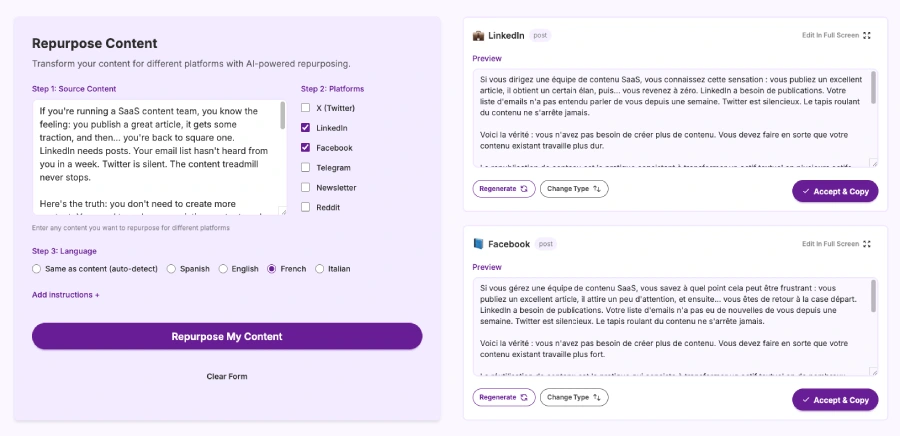
RePurpose.ws is built specifically for text-only content repurposing - the exact use case this guide covers.
The core workflow is straightforward:
- Paste your blog post or long-form article
- Select your target channels: X, LinkedIn, Facebook, Telegram, Reddit, email newsletters
- Get platform-ready text posts in seconds, adapted for each channel's norms and best practices
The tool preserves your brand voice and adjusts tone, length, and structure automatically. You're not getting generic summaries - you're getting content that actually fits each platform.
This is ideal for SaaS content teams that work primarily in documentation and blog posts. You're not trying to repurpose video or audio. You're working with text, and you need more text outputs, faster.
Example: From One SaaS Blog Post to a Multi-Channel Text Pack
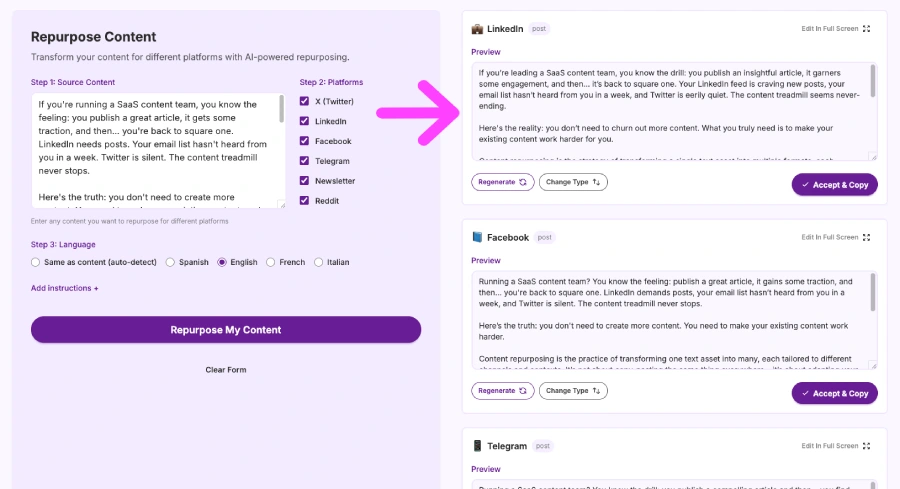
Let's walk through a concrete example.
You publish a 2,500-word blog post about improving free-to-paid conversion rates in SaaS. You run it through RePurpose.ws and specify your target channels.
Within seconds, you receive:
- 1 X thread (8 tweets) that hooks with your most provocative claim and walks through your key framework
- 2-3 LinkedIn posts: one tactical with your step-by-step process, one data-driven highlighting your case study results, one opinion piece on why most SaaS companies get this wrong
- 1 newsletter segment: intro + body formatted for email, with a personal tone and clear CTA to read the full post
- 2 Reddit posts: one story-based ("Here's how we increased conversion 34%..."), one tactical (responding to a common question with your framework)
- 3-5 short tip posts perfect for founder/PM accounts that establish authority without being salesy
That's 10+ pieces of platform-specific content from one article, generated in under a minute.
Your team's role shifts from creation to curation. You review the outputs, make adjustments for brand voice and accuracy, add context specific to current conversations, and schedule publication. The heavy lifting is done.
Where AI Should Not Replace Humans
AI is a productivity multiplier, not a replacement for editorial judgment.
You still need humans for:
- Final fact-checking and product details: AI might misinterpret a technical specification or miss a recent product change. Always verify numbers, features, and claims before publishing.
- Strategic narrative and positioning: AI can adapt your content, but it can't make strategic decisions about which messages to amplify, which audiences to prioritize, or how to differentiate against competitors.
- Sensitive or regulated topics: If you're in healthcare, finance, or another regulated space, human review isn't optional - it's required.
The best workflow is AI for speed, humans for strategy and accuracy.
Building a Repurposing Workflow for Your SaaS Team

Define Roles and Ownership
Repurposing only works when someone owns the process.
Assign clear responsibilities:
- Content lead or PMM: Chooses which source content to repurpose, prioritizes based on business goals, ensures alignment with positioning and campaigns.
- Writer or editor: Drafts and edits repurposed pieces, maintains brand voice, adapts content for each channel's specific norms.
- Social or marketing ops: Handles scheduling and publishing, monitors performance, manages the content calendar.
- AI tools like RePurpose.ws: Sit between the content lead and writer, generating first drafts that the writer refines.
Nobody should be doing everything. Clear ownership prevents bottlenecks and ensures consistent execution.
Step-by-Step Workflow
Here's a repeatable process you can implement today:
- Content audit: Review your existing blog posts, case studies, and documentation. Identify your top performers by traffic, engagement, and conversions.
- Prioritization: Score each piece by business impact (does it support a key initiative?) and repurposing potential (does it contain multiple distinct ideas?). Start with high-impact, high-potential content.
- Briefing: For each piece you're repurposing, define target channels, key angles for each channel, and target personas. Don't skip this step - clarity here saves time later.
- Drafting: Use your templates and tools like RePurpose.ws to generate first drafts quickly. For channels where you have less experience, lean more heavily on AI outputs as a starting point.
- Editing: This is where humans add the most value. Review for accuracy, adjust tone for brand voice, add timely context or references, and ensure each piece serves a clear strategic purpose.
- Publishing: Schedule across channels with appropriate spacing. Don't blast everything at once - spread it out to maintain consistent visibility.
- Measurement: Track performance by channel and content type. Feed winning formats and topics back into your prioritization process.
This becomes your weekly or monthly rhythm. It's not glamorous, but consistency beats inspiration.
Documentation and Templates
Build a library of reusable assets:
- Repurposing checklists per channel: "When adapting for LinkedIn, always… When adapting for Reddit, avoid…"
- Prompt templates for AI tools: "Turn this into a LinkedIn post that… Extract the key data points and format them as… Rewrite this for a Reddit audience who…"
- Style guides and examples: Show your team what good repurposed content looks like for each channel. Examples are more valuable than guidelines.
As you create more content, capture what works and turn it into a template. Your process should get easier and faster over time, not harder.
Measuring the Impact of Text Content Repurposing
Key Metrics Across the Funnel
Different metrics matter at different stages.
Top-of-funnel metrics: Track impressions and engagement rates on social posts, traffic to your key blog posts and landing pages, and growth in your social following and newsletter subscribers. These measure reach and awareness.
Mid-funnel metrics: Monitor time on page for your content, conversion rates from content to newsletter signup or demo requests, and click-through rates from social posts to deeper content. These measure interest and consideration.
Bottom-funnel metrics: Look at influenced opportunities where content played a role in the sales process, closed-won revenue from content-sourced leads, and expansion revenue from customers who engaged with educational content. These measure revenue impact.
Not every piece of content will drive demos or revenue directly. That's okay. Your top-of-funnel content's job is to build awareness and authority. Your bottom-of-funnel content's job is to remove friction and drive decisions.
Content-Specific Metrics
Track metrics that are unique to repurposing:
- Content reuse ratio: How many derivative assets are you creating per hero post? If you're only getting 3-4 pieces from each blog post, there's room to improve. Aim for 10-15.
- Winner tracking: Which source articles consistently generate successful repurposed posts? Double down on those topics and formats.
- Channel fit: Which platforms respond best to your repurposed text content? You might find that LinkedIn consistently outperforms X for your audience, or that Reddit drives more qualified traffic than either. Let the data guide your channel prioritization.
Reporting and Feedback Loops
Make measurement actionable with regular reviews.
Monthly review: Identify your best-performing repurposed pieces. What made them work? Was it the topic, the angle, the channel, the timing? Update your templates and processes based on what you learn.
Reverse repurposing: When a repurposed piece significantly outperforms the original, consider expanding it into a deeper asset. A LinkedIn post that gets massive engagement might deserve to become its own comprehensive blog post.
The goal isn't just to create more content - it's to get smarter about what content works and why.
Common Mistakes in SaaS Content Repurposing (and How to Avoid Them)
Copy-Pasting Without Adapting
The biggest mistake is treating repurposing like syndication.
If you paste the same text to LinkedIn, X, and Reddit, you'll get mediocre results everywhere. Each platform has different norms for length, tone, formatting, and what kind of content gets engagement.
The fix: Actually adapt your content. Change the structure for each platform. Adjust the tone. Cut or expand based on channel norms. Your blog uses formal headers and long paragraphs; your LinkedIn post uses hooks and white space; your X thread uses short sentences and line breaks.
Losing the Strategic Thread
Some teams get so focused on repurposing that they lose sight of strategy.
You end up with dozens of random posts that don't connect to your core product narratives or business goals. You're busy, but you're not building toward anything.
The fix: Align your repurposing roadmap with your product and revenue goals. If you're launching a new feature, your repurposing efforts should support that launch. If you're entering a new market segment, your content should speak to that audience's specific needs. Every piece of content should tie back to a strategic objective.
Over-Relying on AI
AI tools are powerful, but they're not magic.
If you publish AI-generated content without editorial review, you'll end up with off-brand writing, factual errors, and generic messaging that sounds like everyone else.
The fix: Always add human editorial review. Use AI to generate first drafts and save time, but rely on humans for accuracy, brand voice, strategic positioning, and the subtle context that makes content actually good.
Ignoring SEO and Cannibalization
When you repurpose aggressively, you can accidentally create multiple pieces targeting the same keyword.
This leads to keyword cannibalization where your own content competes with itself in search results, diluting your authority and confusing search engines.
The fix: Plan your content clusters intentionally. If you're creating multiple posts from one topic, make sure each targets a distinct search intent. Use internal linking to make the relationships clear. Your pillar post about "SaaS metrics" should link to your cluster posts about "CAC payback period" and "net revenue retention," each of which serves a different search query.
Getting Started: Playbooks for Different Team Sizes
Solo Founder or 1-Person Marketing Team
You're resource-constrained, so focus on the highest-leverage activities.
Weekly rhythm: Publish one blog post per week. Then repurpose it into:
- 1 newsletter (featured article or excerpt)
- 1 X thread (5-8 tweets summarizing key points)
- 2 LinkedIn posts (one tactical, one opinion-based)
- 1-2 community posts (Reddit or relevant Slack/Discord communities)
Use RePurpose.ws to generate first drafts of all these formats in minutes, then spend 30-60 minutes editing and refining. You've just maintained presence across five channels without writing from scratch five times.
Small SaaS Team (2-5 Marketers)
You have enough people to specialize, so build a simple system.
Maintain a content calendar with a "hero asset of the week". Each week, one substantial piece of content becomes the focus of your repurposing efforts.
Assign one person to own the repurposing process: they manage the grid, track metrics, and ensure nothing falls through the cracks.
Use AI tools to handle first passes, but have your writer or editor refine everything before publication. This is where quality control happens.
Schedule a monthly review where you look at what's working and what isn't, then adjust your process accordingly.
Larger Content Teams
At scale, you need formal systems and dedicated resources.
Build a "content repurposing squad" with clear roles: strategist, writer/editor, designer (if you're creating visual formats of text content), and social manager.
Integrate repurposing into campaign planning, not as an afterthought. When you plan a product launch or content campaign, the repurposing strategy should be part of the initial brief.
Standardize your templates and prompts. Everyone should be working from the same playbook, using the same AI prompts, and following the same quality standards.
Regularly refine based on analytics. With more content and more channels, you have more data. Use it to get smarter about what works for your specific audience and business.
Conclusion: Make Your Text Content Work 10x Harder
Content repurposing isn't a nice-to-have anymore - it's how SaaS companies maintain visibility without burning out their teams.
The insight that changes everything: you don't need more content first. You need to get more from the content you already have.
Most of your best content is sitting dormant on your blog, reaching a fraction of the audience it could reach. Every comprehensive guide, every insightful case study, every detailed tutorial contains enough ideas to fuel weeks of content across multiple channels.
The barrier isn't creativity or resources - it's process. Once you have a repeatable system for identifying strong source content, breaking it into idea atoms, and adapting it for different channels, repurposing becomes as routine as publishing.
Here's your first step: Pick your best-performing article from the last six months. Run it through RePurpose.ws and select 3-4 target channels. Take the outputs, adapt them to your brand voice, and schedule them over the next two weeks.
That's your content repurposing engine in action. Now you just need to repeat it.
Posted by
 Di Reshtei