Key Takeaways
- Your brand voice is what makes you recognizable. AI tools can speed up content creation by 10x, but generic output kills authenticity
- Most creators lose their unique tone within weeks of adopting AI rewriting tools. This guide shows you how to set up guardrails that keep your voice intact while using AI to scale content across platforms
- Three things you need: reference content from your best work, platform-specific style rules, and prompts that enforce your vocabulary patterns. Get these right and AI becomes your amplifier, not your replacement
Why AI Rewriting Threatens Your Brand Voice

AI models default to neutral, corporate prose. They favor predictable sentence structures. Remove contractions. Avoid slang. The result? Content that sounds like every other AI-generated post flooding the internet.
When you use ChatGPT or similar tools without guardrails, you get standardized output. Your personality vanishes. Readers notice. Engagement drops because people connect with authentic voices, not polished robots.
Here's what happens: You paste a blog post into an AI tool. Ask it to "rewrite for LinkedIn." The AI strips out your edge. Removes conversational bits. Adds corporate jargon you'd never use. Now your LinkedIn post sounds nothing like your blog.
This damages trust over time. Your blog readers follow you to LinkedIn. They expect the same person. Instead they find sanitized corporate speak. That disconnect erodes your authority.
The Reference Content System
Build a library of your best writing. Pick 5-10 pieces that capture your authentic voice. Blog posts where you really let loose. Emails that got great responses. Social posts that sparked conversations.
Feed these to your AI tool as reference material. Tools like RePurpose.ws let you store reference content for each platform. The AI analyzes your patterns: sentence rhythm, word choices, how you open and close pieces, your humor style.
What to include in references:
- Your strongest opinion pieces show your values
- Tutorial content reveals how you explain complex ideas
- Response posts demonstrate how you engage
- Rant posts expose your real voice when filters drop
Mix formats too. Short punchy posts. Long analytical pieces. Casual updates. This range helps AI understand when to match which mode.
Update references quarterly. Your voice evolves. What you wrote two years ago might not reflect current style. Keep the library fresh with recent work that feels authentic.
Platform-Specific Style Rules
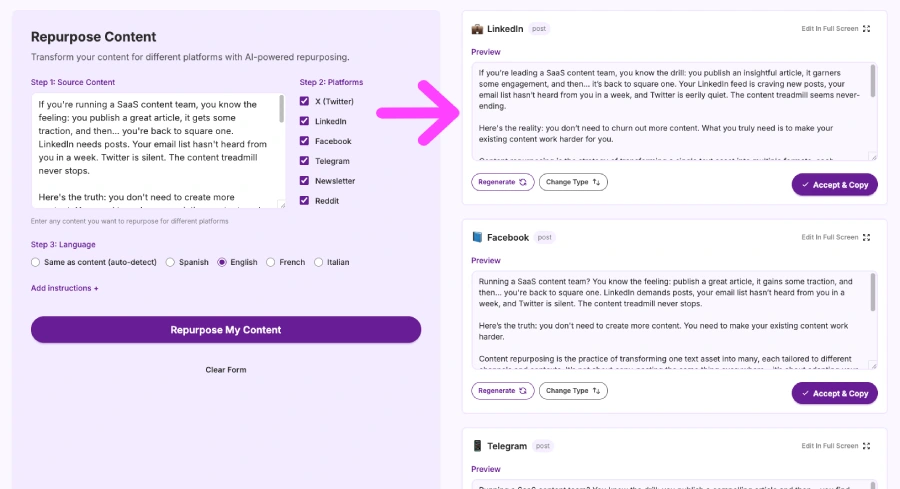
LinkedIn isn't Twitter. Facebook isn't Reddit. Each platform has unwritten rules about tone, length, formatting. Your AI needs explicit instructions for each.
For LinkedIn
Professional but not corporate. Tell the AI to keep contractions. Use "you" and "we" liberally. Stories over abstractions. No buzzword soup. Length between 150-300 words for posts. Threads can go longer but break every 3-4 sentences.
For Twitter/X
Punchy and direct. Threads need hooks in first tweet. Each tweet stands alone but flows into next. Use line breaks for emphasis. Questions engage better than statements. Humor lands better than seriousness.
For Newsletters
Conversational and detailed. Longer sentences work here. People subscribed for depth. Explain fully. Personal anecdotes build connection. Sign off with your actual name, not "Best regards."
For Reddit
Cut the marketing speak entirely. Reddit users smell promotion from miles away. Lead with value. Answer the implicit question: "Why should I care?" Acknowledge weaknesses in your argument. Community first, self-promotion last.
Document these rules. Give them to your AI tool every time. Don't assume it remembers from last session.
Prompt Engineering for Voice Consistency
Generic prompts get generic results. "Rewrite this for LinkedIn" produces corporate mush. You need specific, layered instructions.
Base prompt structure:
Rewrite this content for [platform].
Voice requirements:
- Maintain my conversational tone with contractions
- Keep sentences between 8-20 words, varying lengths
- Use active voice only
- Include 2-3 questions to drive engagement
- No corporate jargon or buzzwords
Format requirements:
- [Platform-specific formatting rules]
Never use: [Your banned words/phrases]
Reference style: [Paste 2-3 paragraphs of your best work here]
The banned words list matters more than you think. Every writer has terms they'd never use. Mine includes "leverage," "synergy," "circle back," "touch base." AI loves these corporate zombies. Explicitly ban them.
Tone modifiers work. Add "slightly sarcastic," "enthusiastically curious," "skeptically analytical." These nudge AI toward specific flavors of your voice.
Examples beat descriptions. Don't say "write casually." Show casual. Paste three sentences you wrote casually. AI pattern-matches better with concrete examples.
Testing Your Guardrails
Generate five versions of the same content. Don't edit. Read them aloud. Which ones sound like you actually speaking?
The speaking test is brutal but effective. AI often passes the reading test but fails when vocalized. You'd never say "facilitate synergy" out loud. Strike anything that sounds weird when spoken.
Compare engagement metrics too. Post AI-rewritten content. Track responses. Are people engaging like they did with your manual posts? Comments quality matters more than quantity. Are people responding to your actual points or just dropping generic replies?
A/B test systematically. One week manual posts. Next week AI-assisted with guardrails. Watch your analytics. Follower growth. Click-through rates. Reply depth. The data tells you if guardrails work.
Adjust based on feedback. If people say "this doesn't sound like you," your guardrails failed. If they engage normally, you're good.
Common Mistakes That Kill Authenticity
Mistake one: using the same prompt for every platform. Each channel needs different energy. LinkedIn you can be more formal. Twitter demands brevity. Reddit requires authenticity. One-size-fits-all prompts produce one-size-fits-none content.
Mistake two: no vocabulary constraints. AI defaults to formal language. Without explicit instructions to use "get" instead of "obtain," "use" instead of "utilize," you'll sound like a manual nobody reads.
Mistake three: ignoring rhythm and pacing. Your natural writing has a beat. Some sentences flow long and meandering. Others hit hard and stop. AI defaults to medium-length sentences unless told otherwise. Specify sentence length variation in your prompts.
Mistake four: forgetting your quirks. Maybe you always start with questions. Or use sports metaphors. Or drop pop culture references. These signature moves make you recognizable. Tell the AI to include them.
Mistake five: over-editing AI output. If you're rewriting 80% of what AI produces, your guardrails don't work. Either fix the prompts or question whether AI helps at all. The goal is 20% editing max.
Advanced Techniques for Voice Protection
Create platform-specific personas. Write a one-page character sketch for each channel. "On LinkedIn I'm the experienced practitioner sharing lessons learned. On Twitter I'm the skeptical observer questioning assumptions. On Reddit I'm the peer contributor adding one perspective among many."
Give these personas to your AI. Context shapes output more than you'd expect.
Build a negative examples library. Save AI outputs that failed. Mark what went wrong. "Too corporate here." "Lost my humor here." "Wrong vocabulary here." Show these to AI: "Never write like these examples."
Version your prompts. LinkedIn Prompt v3.2. Twitter Prompt v2.7. Track what works. When engagement drops, roll back to previous version. Treat prompts like code.
Use staging before publishing. Generate content. Wait four hours. Read again with fresh eyes. Does it still sound like you? Rushed publishing buries bad AI output that seemed fine in the moment.
Set voice drift alerts. Monthly, pick five AI-generated posts. Compare to five manual posts from same period. Getting too similar? Your voice is being averaged out. Tighten guardrails.
Tools and Workflows That Preserve Voice
RePurpose.ws solves this exact problem. You paste blog content. Select target platforms. The system maintains your voice because you've trained it with reference content. It doesn't guess your style from generic data. It learns from YOUR actual writing.
The workflow: write one strong piece. Usually a blog post. Feed it to the tool. Get platform-optimized versions that sound like you wrote them natively for each channel. Edit the 15-20% that needs tweaking. Publish everywhere.
Time savings: most creators spend 10-15 hours weekly repurposing content manually. That drops to under an hour with proper AI guardrails. Not because you're cutting corners. Because the system actually understands your voice parameters.
The control stays with you. Every output is editable. Regenerate if the first pass misses. Change formats with one click. The AI suggests optimal format for each platform but you decide.
Voice consistency comes from reference training. During onboarding you'll add examples of your best work. The system analyzes patterns. Updates as you add new references. Your voice evolves, the AI adapts.
Measuring Success: Is Your Voice Protected?
Track these metrics monthly:
- Engagement rate per platform. Comments, shares, meaningful interactions. If this drops after implementing AI, your voice guardrails aren't working.
- Follower retention. Are people unfollowing? Voice changes trigger unfollows. Your audience signed up for a specific person. Deliver that person.
- Content production speed vs quality. You should produce 3-5x more content without quality drops. If speed increases but engagement falls, you're sacrificing voice for volume.
- The "sounds like you" test. Ask five trusted followers. Show them AI-rewritten content. Don't label it. Ask: "Does this sound like me?" If they hesitate or say no, adjust your guardrails.
- Reply quality. Generic content gets generic replies: "Great post!" "Thanks for sharing!" Authentic voice gets specific replies engaging with your actual points.
Conclusion: AI as Voice Amplifier, Not Replacement
AI rewriting tools give you reach. Guardrails give you authenticity. You need both.
The goal isn't perfect AI that replaces you. It's augmented workflow where AI handles mechanical parts - formatting, platform optimization, length adjustment - while you control voice elements that make content yours.
Your brand voice took years to develop. Protect it. Set up reference libraries. Write detailed platform rules. Test religiously. Track metrics. Adjust constantly.
Done right, AI lets you maintain authentic voice across eight platforms instead of one. Same person, more places, bigger audience.
Ready to Scale Your Content?
Ready to scale your content without losing your voice? Try RePurpose.ws and see how platform-optimized repurposing keeps your authentic tone intact. Paste your best content, train the model with your references, and get platform-ready posts in under 60 seconds. Your voice, preserved. Your reach, multiplied.
Posted by
 Di Reshtei